91²Ö¿â Today will be following a group of Golden Flashes for the 2025-26 academic year, chronicling their efforts and successes during the fall and spring semesters. The group of students is at various places in their 91²Ö¿â academic careers and will share their experiences throughout the year as they take part in our distinctive programs, research and global experiences.
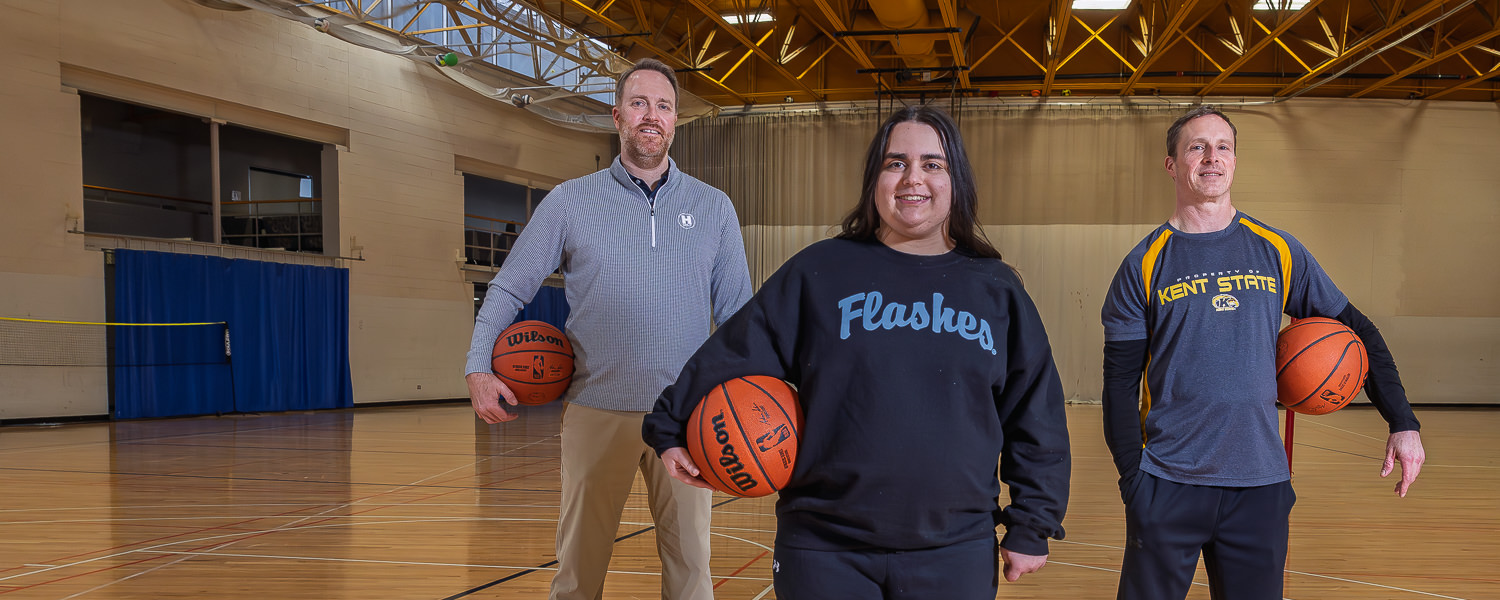
When we first met Julia Michalak (read our first interview with Julia here), a senior in the Physical Education and Sport Performance program, in November 2025, she shared how the dread she felt going to gym class as a kid became the driving force behind her decision to become a physical education teacher. Now, as she prepares to graduate in May, we check back in – this time with Michalak and the two professors she credits with keeping her inspired along the way.
When Julia Michalak arrives at Woodridge High School to student teach each morning, she is, in a sense, returning to the scene of the struggle. It was not at this school specifically, but close enough. Woodridge is only a few minutes from her hometown of Cuyahoga Falls, Ohio, where, as a kid with cerebral palsy, she dreaded walking into gym class.
Now, Michalak is the one running the gym class, making sure it’s a welcoming environment for all.
"I think at each level – middle school, then elementary, then high school – I'm learning something different," Michalak said. "But I will say, student teaching at the high school level has definitely been my biggest challenge, even just two weeks in."
Michalak didn't grow up playing sports, and the physical education curriculum at the high school level is dense with them. She's currently teaching a game called Speedball, a hybrid of basketball, soccer and handball, and admits that she and her students are sometimes figuring out the rules at the same time.
"There are moments when the students are confused, and I'm trying to explain it to them, and I'm still processing it myself," she said with a laugh.
But some of the challenges are more personal. Michalak was born with a mild form of cerebral palsy that causes stiffness in her legs, and she also has strabismus, a condition affecting her eyes and visual processing. This can make things difficult when trying to demonstrate certain movements or when setting up equipment for in-class games.
"Setting things up is something I really struggle with. It's simple stuff that I think other people take for granted," she said. "I can't control it, so I just have to do the best that I can."
But this is not a story about Michalak’s limitations; this is a story about Michalak’s ability to overcome any challenge set before her, thanks to her powerful mindset.
Teaching With Her Whole Self
Across her field experience placements – Richardson Elementary School in Cuyahoga Falls, Stanton Middle School in Kent, and now Woodridge High School in Cuyahoga Falls – Michalak has been building a picture of the kind of teacher she wants to be, and the kind of physical education class she wants to run.
Her vision is deliberately non-traditional. She wants to bring fencing into the curriculum. She's taught Greek folk dance to elementary school kids. She wants fitness, movement and team-building activities to sit alongside team sports, so that students who don't excel in traditional team sports still have a place to shine.
"I want to create a lot of non-traditional activities that you don't do in PE that could expose kids who don't enjoy those traditional sports," she said, "so that PE can be looked at more as an enjoyment than just the team environment they're always used to."
Her favorite activity to teach, she says, isn't one most people might expect.
"Team building," she said without hesitation. "Because you actually get to know the people in your class for who they are. You could incorporate exercise, but also just silly little things, like if you could eat one food for the rest of your life, what would it be? And then you're doing physical activity at the same time."
Her unique approach goes back to her own experience of feeling invisible in gym class, and her newfound belief that physical education, when done right, can be the most powerful class in a school.
"It's where you have to be public in front of other people with your ability," she said. "So, if you struggle, they're going to know about it. But I think it can give you strength. If you can find a way to be emotionally confident in PE, you'll be okay in other subjects, too."
She's also open with her own students about her disability. When she meets a class for the first time, she tells them about her cerebral palsy. She lets them know she may need help demonstrating certain activities. During her elementary placement, she met a boy who wore leg braces, just as she had as a child.
"You could tell it made him feel good when I told him I used to wear those too," she said.

‘They Make Me Feel Like It's a Superpower’
When asked where she finds her sense of resilience, Michalak credits two people again and again: Kevin Eckert and Doug Ellison, Ph.D., both faculty in 91²Ö¿â's Physical Education and Sport Performance program.
Michalak first reached out to Eckert, associate lecturer in the Physical Education and Sport Performance and program coordinator for Physical Wellness and Sport, before she had even set foot on campus, sending him an email laying out all her concerns about joining a program as a student with a physical disability.
"I think it's the nicest email I've ever gotten back," she said. "I didn't even know him, but it just oozed support."
Then, she met Ellison, associate professor and program coordinator for Physical Education and Sport Performance, in her second semester, and the two professors together became, in her words, "like my angels since I came here."
Michalak said that in the moments that she felt frustrated by her physical limitations, Eckert and Ellison kept her focused on the positives. "They make me feel like it's more of a superpower of mine rather than a struggle," she said. "And I'm very grateful for that."
Eckert was quick to turn the credit back around to her.
"I know she talks a lot about us," he said, "but I can tell you we probably got far more from her than she ever gets from us."
He said having a student with physical limitations in a program where most students come in with strong athletic backgrounds allowed him and Michalak’s fellow students to think more carefully about adaptability and inclusion — not just as concepts to teach, but to practice.
“It made me a better teacher because when our students go out and they teach, we talk about adapting things and modifying things because we want to engage with every student, and that's a real huge challenge,� Eckert said. “And the way she elevated the students around her was just awesome.�
He added that Michalak's openness about her condition has had a visible impact on the other students in the program as well.
"Part of the reason students stop being physically active is because they feel self-conscious about it," Eckert said. "And here's this young kid, getting in front of them and saying, 'I have this issue.' The simplest things that we take for granted — gripping, holding — are such a challenge for her, and yet she's out there doing it."
Tight-Knit Support That Celebrates Your Strengths
“We do have a philosophy here at 91²Ö¿â and in our PE program,â€� Ellison explained. “Overall, we try to build in our students from the start that you all have strengths. There's something in you that is of value to someone you're going to teach or coach. Now we need to build this system around you to help grow that strength.â€�
The one-on-one support Michalak received from Eckert and Ellison made all the difference in her academic experience – but she’s not alone in this good fortune. The Physical Education and Sport Performance program is small by design, graduating roughly 20 teaching majors at a time. The smaller cohort, both professors say, is what makes the kind of relationship they built with Michalak possible. Students are with the same faculty from freshman year through graduation, creating what Eckert describes as a "family-type culture."
"My No. 1 sell is always the small atmosphere," he said. "You get to work with the [same] professors throughout your entire career here. It's just that tight-knit kind of thing."
The Physical Education and Sport Performance program, which is part of the School of Teaching, Learning and Curriculum Studies in the College of Education, Health and Human Services, offers three undergraduate degrees, two graduate degrees, one endorsement and one minor.
Wise Words of Advice
With graduation just months away, Michalak is already planning for her next chapter. She plans to pursue a master's degree in exercise science, but isn’t sure what’s next after that, whether it eventually means teaching, personal training or something she hasn't discovered yet.
"My long-term goal is just to make people feel more comfortable while exercising and doing physical activity," she said. "And there are so many ways I can do that. So, I know whatever happens, I'll be okay."
Asked what she would say to another student with a physical disability who was considering physical education as a career path, she didn't sugarcoat it.
"It's going to be hard. I will not lie. This has probably been the hardest four years of my life," she said. "But it's also doable – if you find the right support system. I think you have to really want it, because it is going to test you, not just physically, but emotionally too."
And if she could go back and speak to her middle school self, the girl who once said she never wanted to walk into a gym again?
"I would tell her not to think that a few moments are going to define your lifelong view on something," Michalak said. "My view on PE now is that it's the subject that can teach you the most out of anything. And I was once the person who thought it shouldn't even be in schools."
Eckert’s advice for Julia as she crosses the finish line is simpler, and Ellison agreed: "Just be Julia.�
Ellison added that the skills Michalak worries about are simply a matter of more practice. It’s when Michalak is authentically herself that her magic shines through.
“The stuff that she thinks she needs to work at – you can learn that,� Ellison said. "She has things you just can't measure.�
Stay tuned as we catch up with Michalak one final time as she prepares for graduation in May 2026.
Learn more about 91²Ö¿â's College of Education, Health and Human Services.