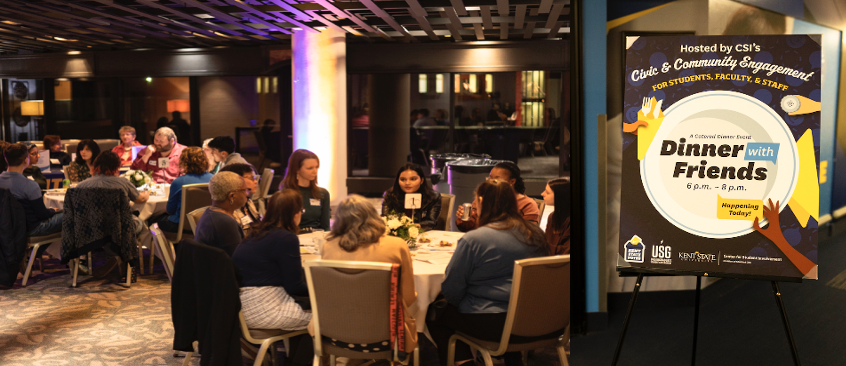
On Feb. 26, a unique event brought together a group of about 50 students, faculty and staff in the Schwebel Room on the third floor of the Kent Student Center for dinner and conversation. By design, the guests come from different areas of the university, and many might have not known each other before meeting at this event. They dined together and had focused discussions about topics of mutual, community interest.
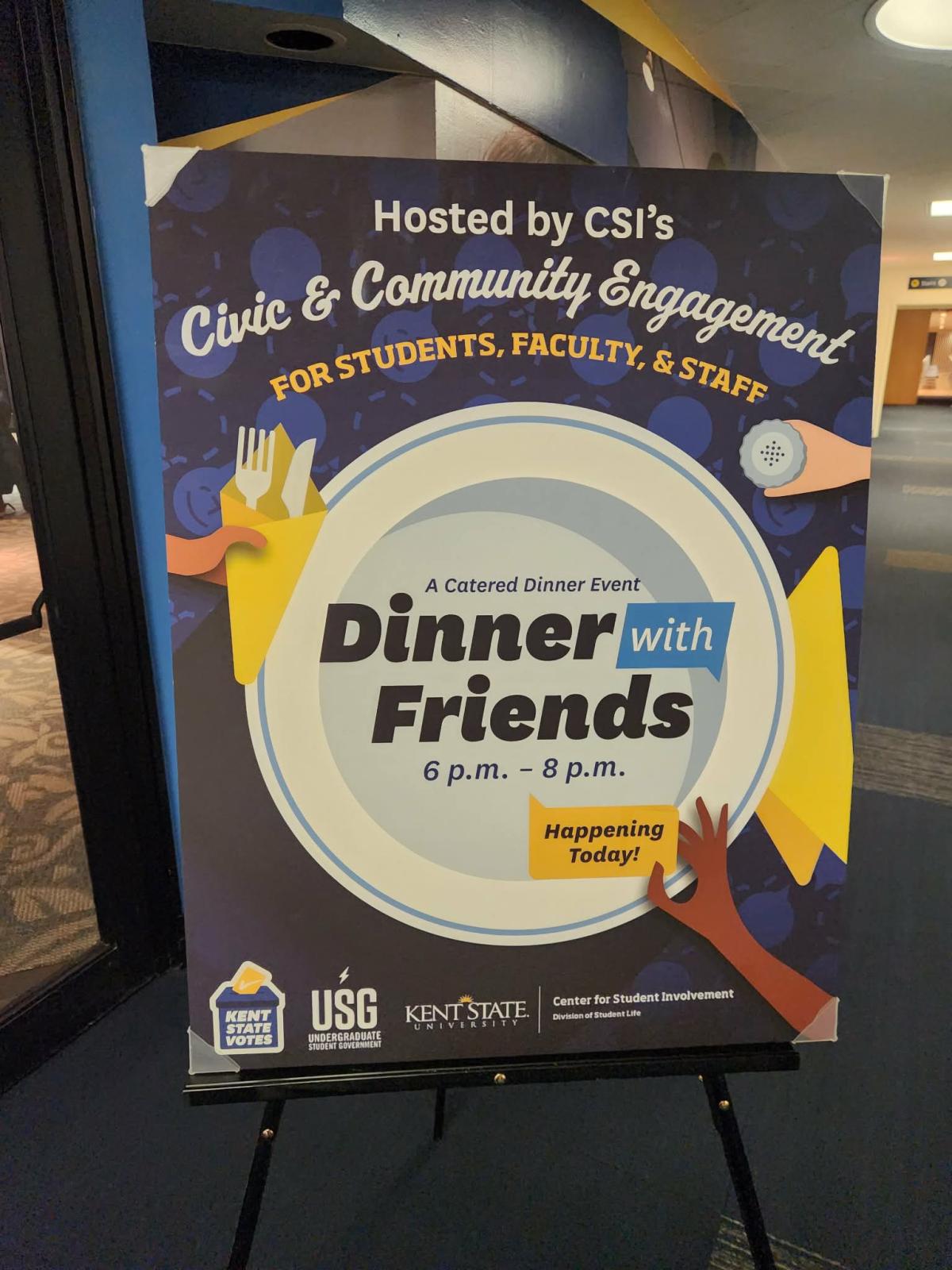
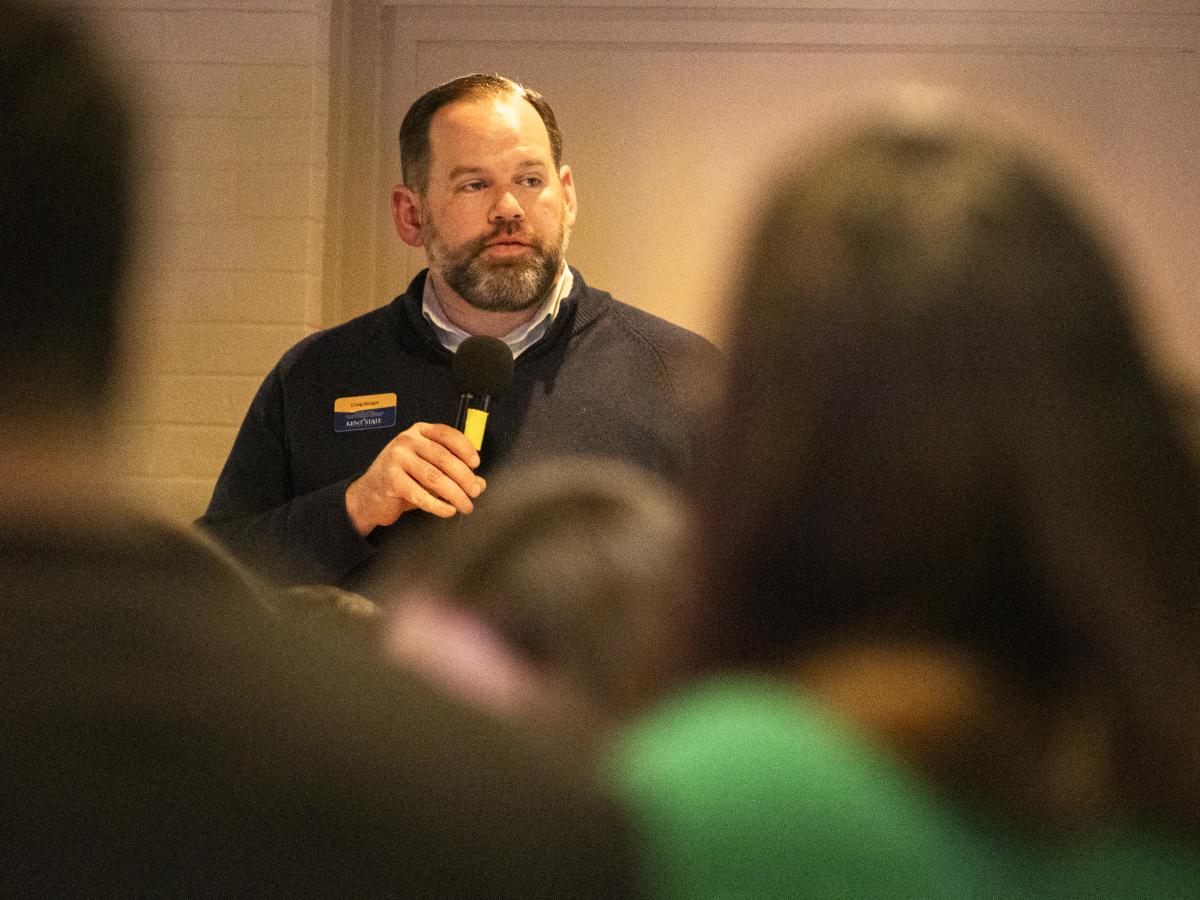
This is “Dinner with Friends,â€� a concept that began as a virtual event in 2021 at the height of the COVID-19 pandemic, brought to life by Craig Berger, associate director for civic and community engagement in 91²Ö¿â’s Center for Student Involvement. He said that the event is designed to knock down divisions in the campus community, specifically around roles, and to bring people together so that some “organic community-building conversation can occur.â€�
'We’re All Part of the Same Community'
Berger noted that since the first virtual event, he has seen further division in the nation and in its communities and he was eager to stage an in-person dinner. “The ideal of actually helping people connect with each other, helping people who are part of a shared community experience come together, have direct interaction and potentially start relationships that go beyond this event was really appealing,� Berger said.
“We’re all human beings first. We’re all part of the same community,� he said. Dinner with Friends is, said Berger, “people who don’t usually sit together at the same table; it’s people who are eating dinner having conversations with people they don’t normally eat with.� Bringing that to the foreground, he said, makes this event different than other events that we have either at the university or elsewhere.
“That is really the most important thing happening; it’s that people are talking with each other,� Berger said.
Dinner – and Discussion – Is Served
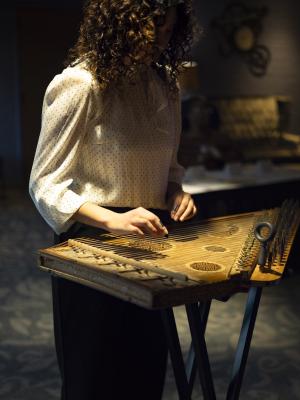
As guests entered the Schwebel Dining room, they were treated to music by Mayara Krifa, a first-year student from Tunisia, playing the Qanun, a traditional Middle Eastern instrument that is played like a harp. Berger and his colleague, Sonia Karkare, program coordinator for civic and community engagement in 91²Ö¿â’s Center for Student Involvement, welcomed guests and co-facilitated the evening's program, guiding participants into small-group conversations at their designated tables. After a brief introduction, dinner was served and the table conversations began.
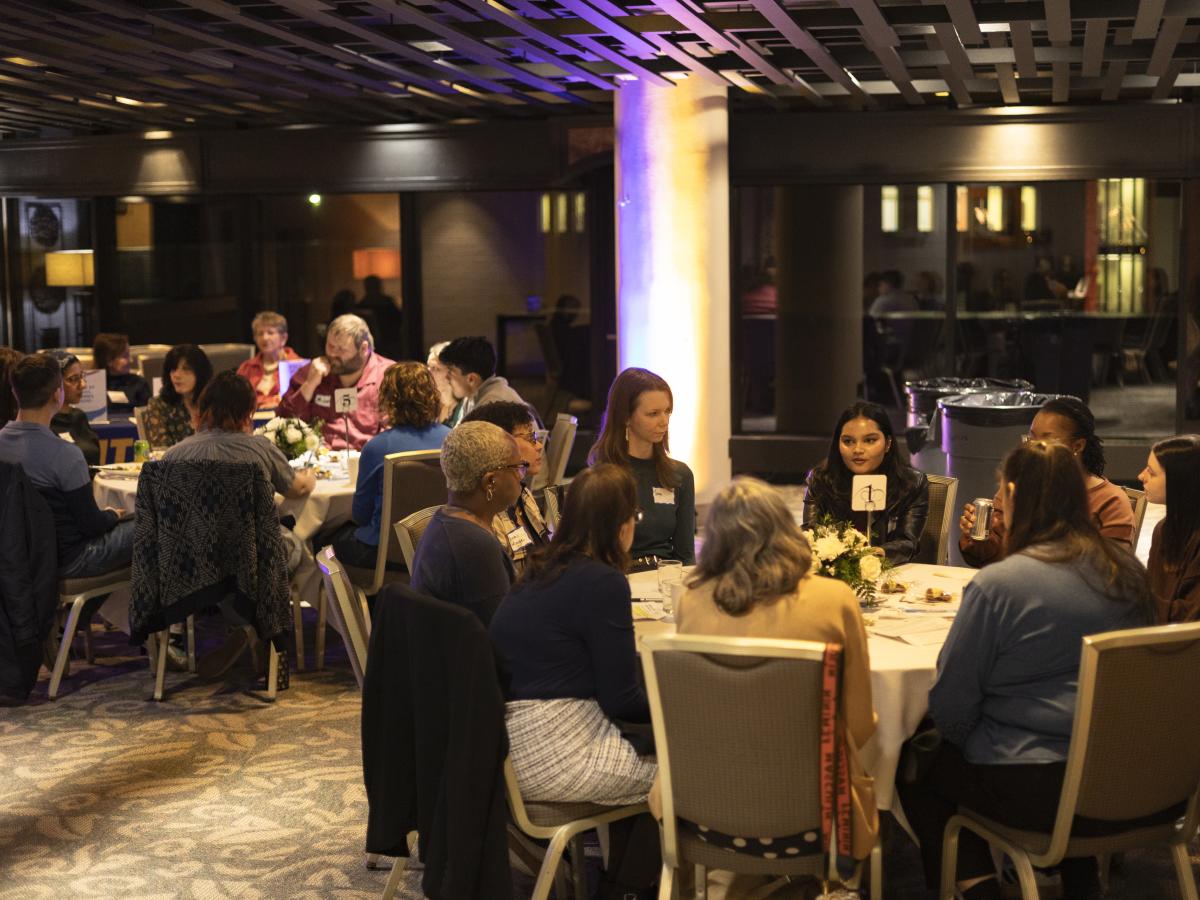
There were five tables, with 10 people each, two of which were trained facilitators. Three tables had different topics to discuss: supporting mental health in challenging times; responding to food insecurity, and advancing environmental sustainability. Two tables shared the topic of finding community on campus and beyond.
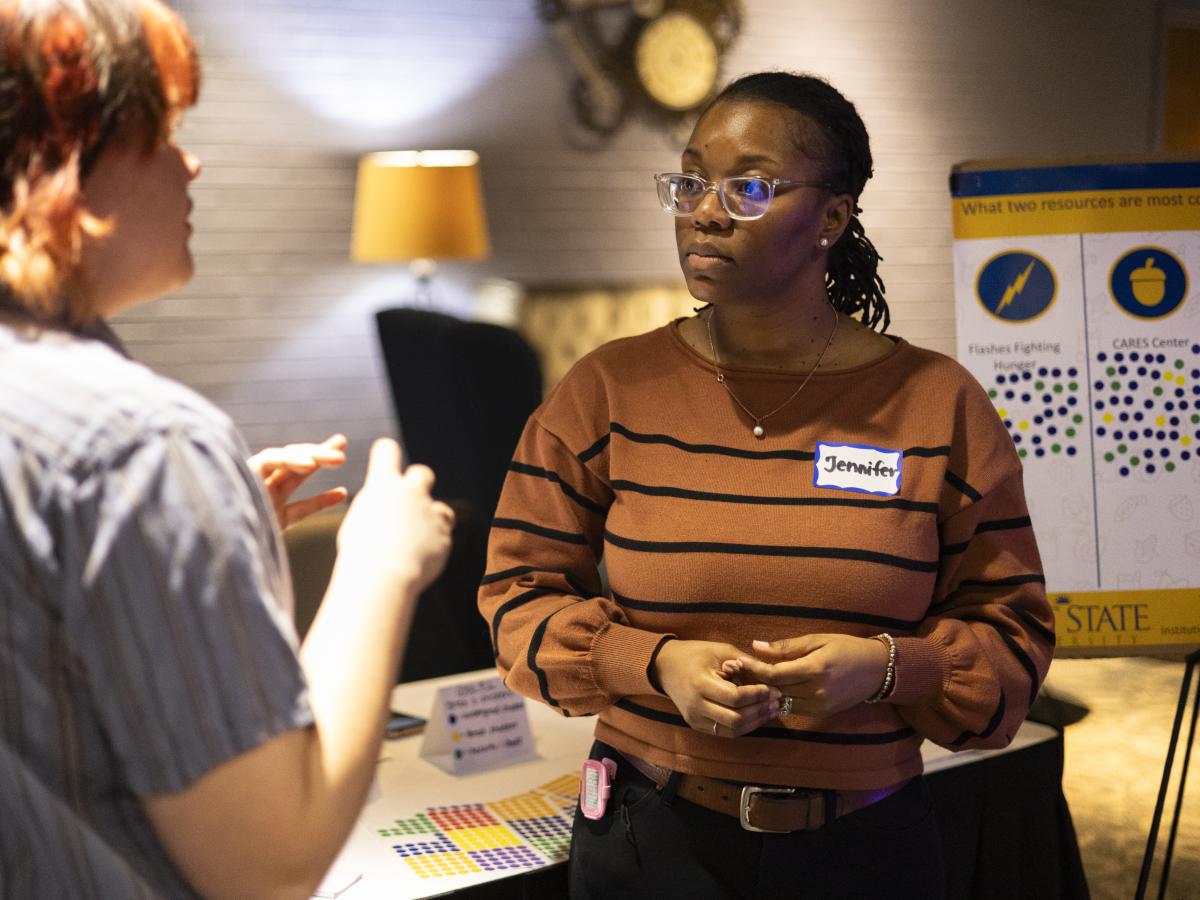
There were also two side tables, one from the League of Women Voters with 91²Ö¿â Associate Professor Emerita Barbara Hipsman Springer and Louise Ditchey, academic program director (retired) and current social chair of 91²Ö¿â Retirees Association and a table inviting event guests to participate in a survey about student food insecurity conducted by Jennifer A. King, Ph.D., assistant professor and center affiliate, 91²Ö¿â Center for Public Policy & Health in 91²Ö¿â's College of Public Health.
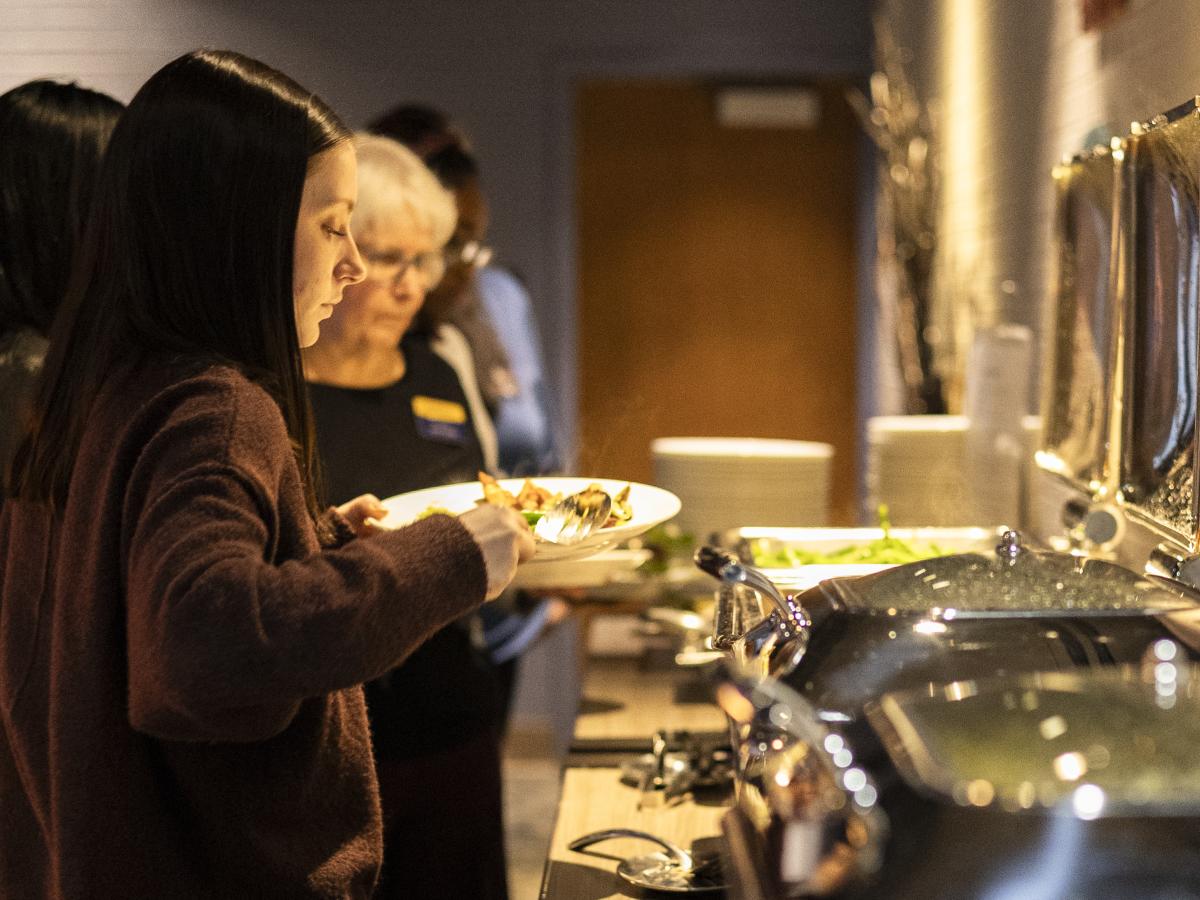
The evening’s buffet was provided by University Culinary Services and included options like grilled honey rosemary chicken, butternut squash ravioli, green beans and blueberry cheesecake for dessert. The menu was designed to accommodate dietary restrictions and religious observances; because the event was during Ramadan, the meal was scheduled to be served after sunset.
Engaging Conversations by Design
Deep thought went into planning how to make this a community-building exercise that would be enjoyable and enlightening, The two facilitators at each table had carefully prepared questions to spark conversation. “The questions are really built to elicit different sets of life experiences in relation to that topic, different viewpoints, different sets of knowledge so that people are not only hearing about each other’s experiences and learning from each other, but they’re also really getting to know one another,� said Berger. “And the odds are that they’re walking away with at least one relationship with a person that they did not know before they came to the event.�
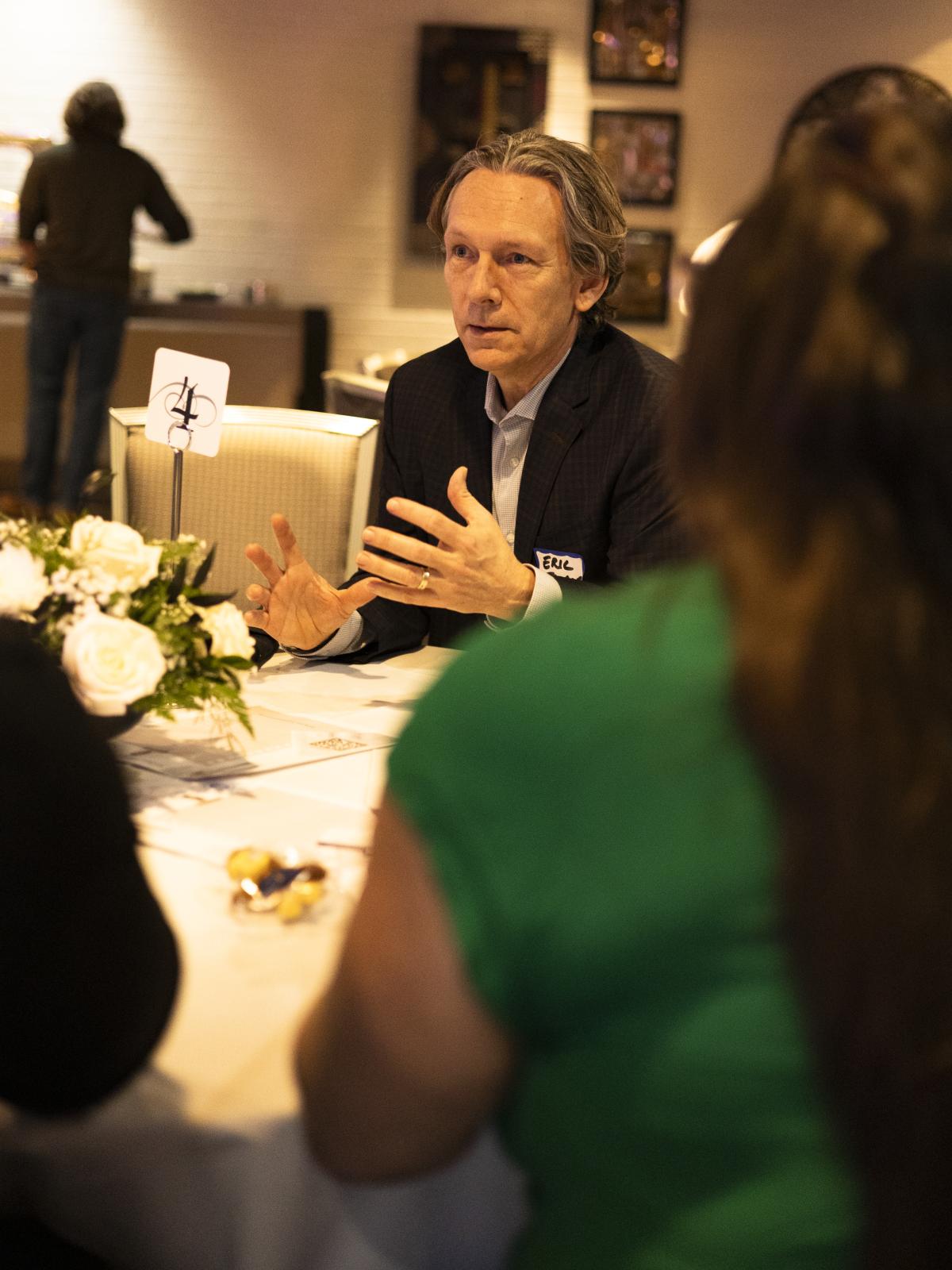
The table assignments are curated to bring together students, faculty and staff with as equal as possible representation at each table. The seatings are also designed to bring together people who may not know each other. Even the expertise is balanced. “On the registration form, we ask guests to rank their topic preferences, and we’re really trying to honor their top two preferences,� said Berger. The goal being to get everyone discussing a topic that is their first or second choice. The event organizers are also seeking to bring together people from different backgrounds with different roles at the university.
Adding a Disruptive Twist
Berger acknowledged that there may be faculty members in attendance who have expertise in a certain topic and they may have made it their first choice. “Part of the goal of this is to actually keep people from following their normal, day-to-day scripts,� said Berger. “Our conventional wisdom is if we have an expert at the table about a certain topic, maybe people would not share as much about their experience with it and defer to (the expert) because they have studied it. We totally want to disrupt that.�
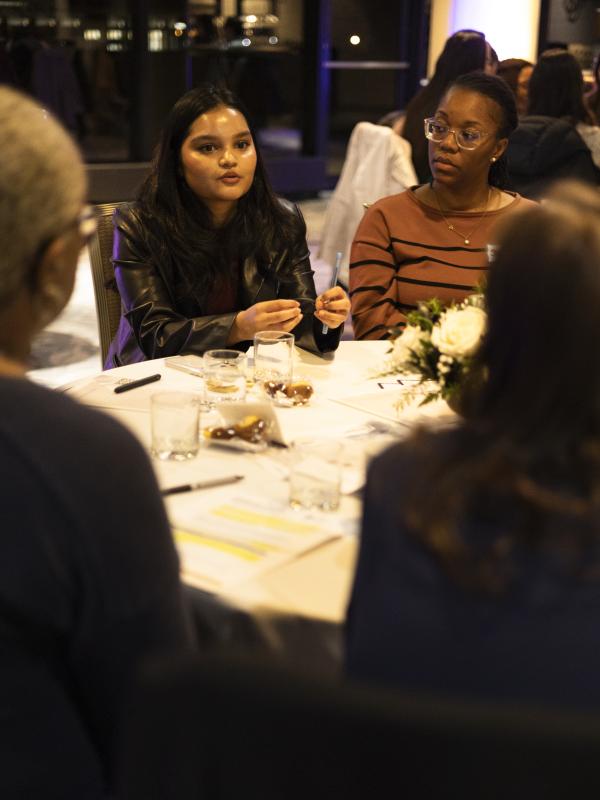
In looking at the overall goals of the program, Berger said, that while that person may have indicated a topic as their No. 1 choice, he might look at their second choice and place them at that table so that “there’s more space for more conversation.�
Summaries Over Blueberry Cheesecake
After dinner, a representative from each table stood and shared what their group had discussed. Each table had a designated note-taker who prepared the summary for the person who spoke and to record the information for use in planning future sessions. Berger said, “Then, part of the plan is that we will check back in, remind people of the event and ask for any updates to see what came of the event for them.�
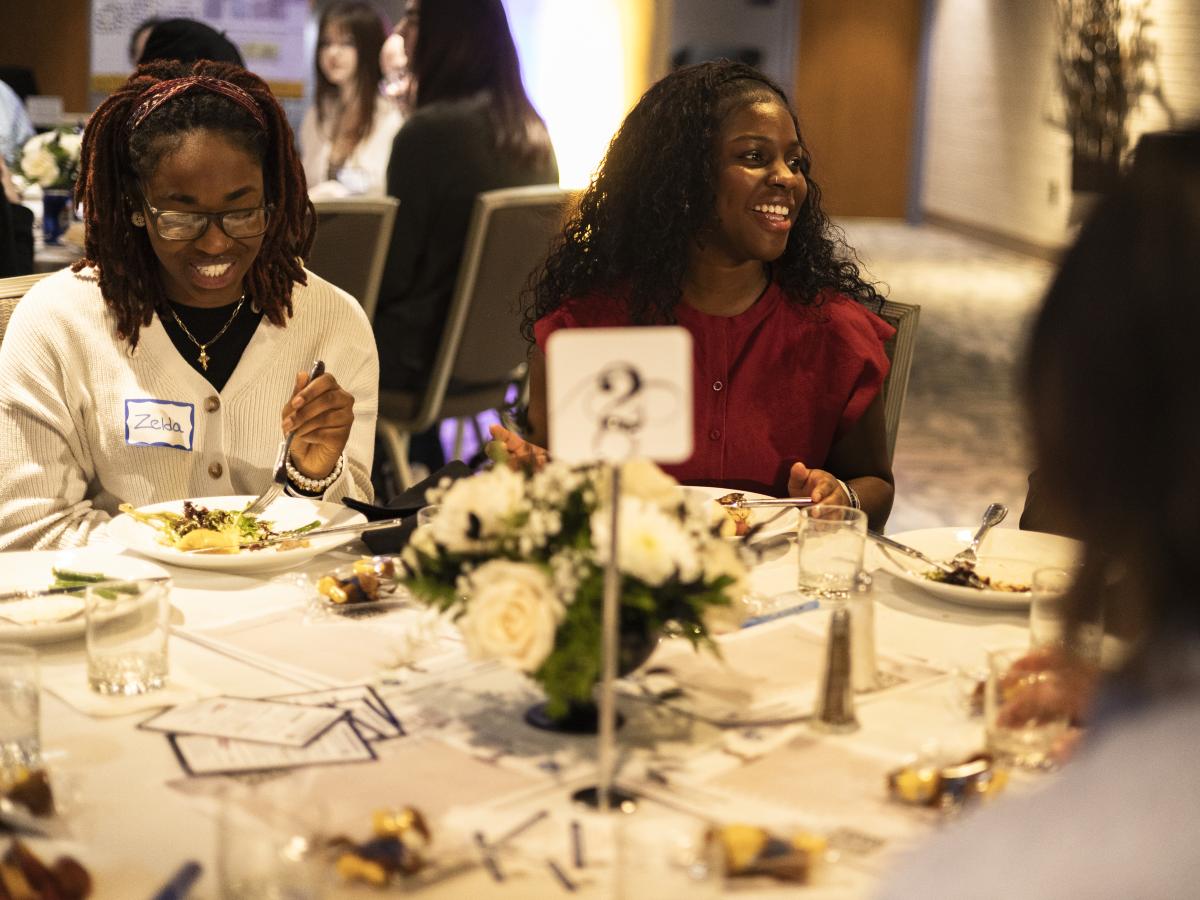
“When we do an assessment after this event, we will be asking ‘Are there people that you now know that you did not know before and you feel comfortable working with to solve a problem?’� Berger said, “That is really the most important thing happening – it’s that people are talking to each other.�
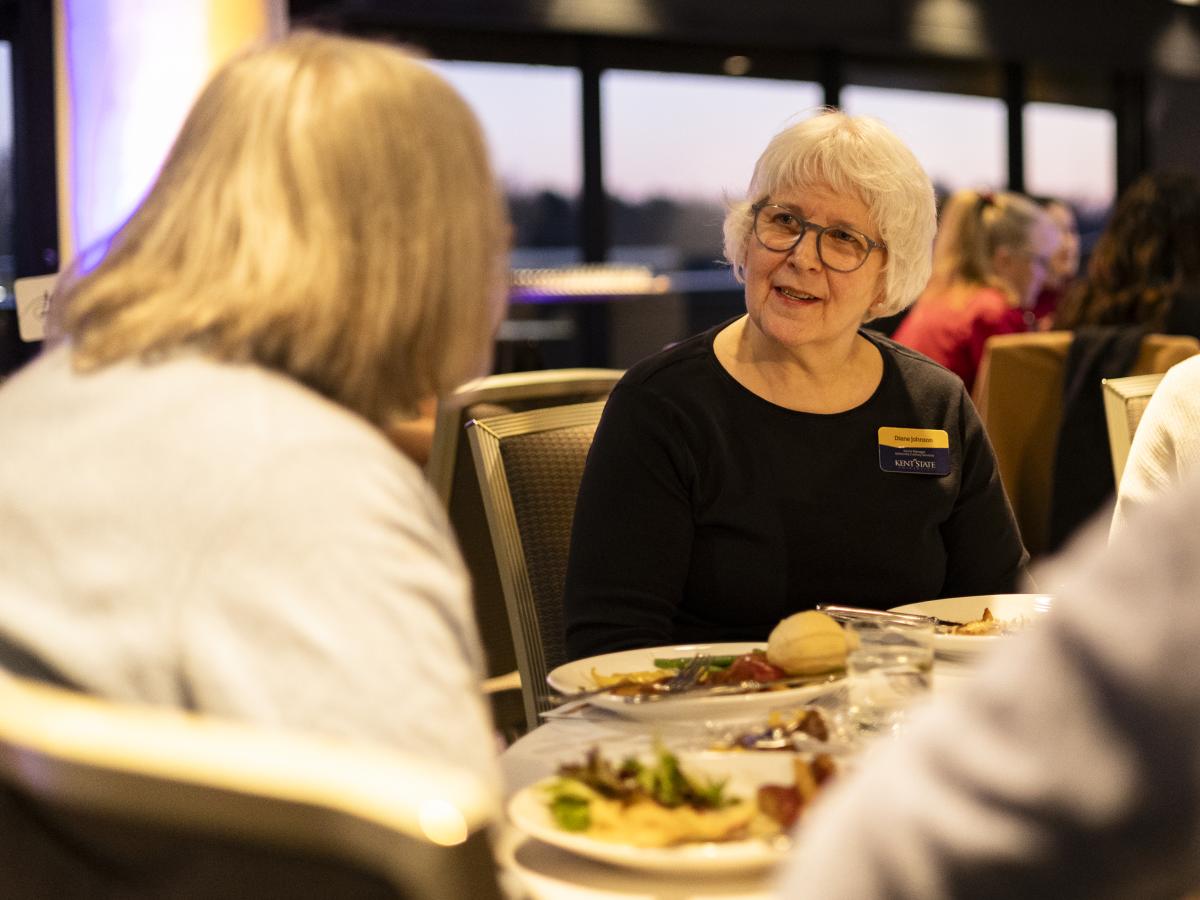
“We have a group of people who have come together who are passionate about the topic,� he said. “We may have a student, a faculty member and a staff member who decide, for example, that for food security, they’re going to work on creating their own community garden or some similar initiative. That’s great and we hope that there might be something that comes from those conversations that might spawn some sort of community change.�
Impressions of Success – From a Student, a Staffer and a Faculty Member
After the event, guests shared their feelings about their table discussions and the “Dinner with Friends� concept.
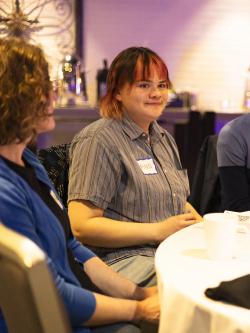
Finn Machuga, a sophomore in 91²Ö¿â's Honors College, from Youngstown, Ohio, majoring in environmental studies and international studies, who is also a current fellow in 91²Ö¿â’s Environmental Science and Design Research Institute, said, “I just met really great people, and we had a really great conversation. I sat at the environmental sustainability table. Environmental's one of those issues where people come to it usually out of worry. Usually, there's some kind of stressor, like they notice, ‘Oh, I used to buy so many clothes, and I don't know where to put them.’ Or, ‘Oh, I don't know how to get to ... I can't walk to Walmart from here, or I'm worried that I'm driving everywhere and it's making me feel bad because of my impact.’ So I feel like environmental is one of those issues that kind of start with an anxiety and then we build off of it and through our connections, we were able to come up with not only some solutions, but some sustainable pathways to keep making a difference, not just in those original issues, but to keep following up and building a better world for ourselves.â€�
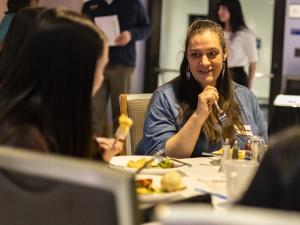
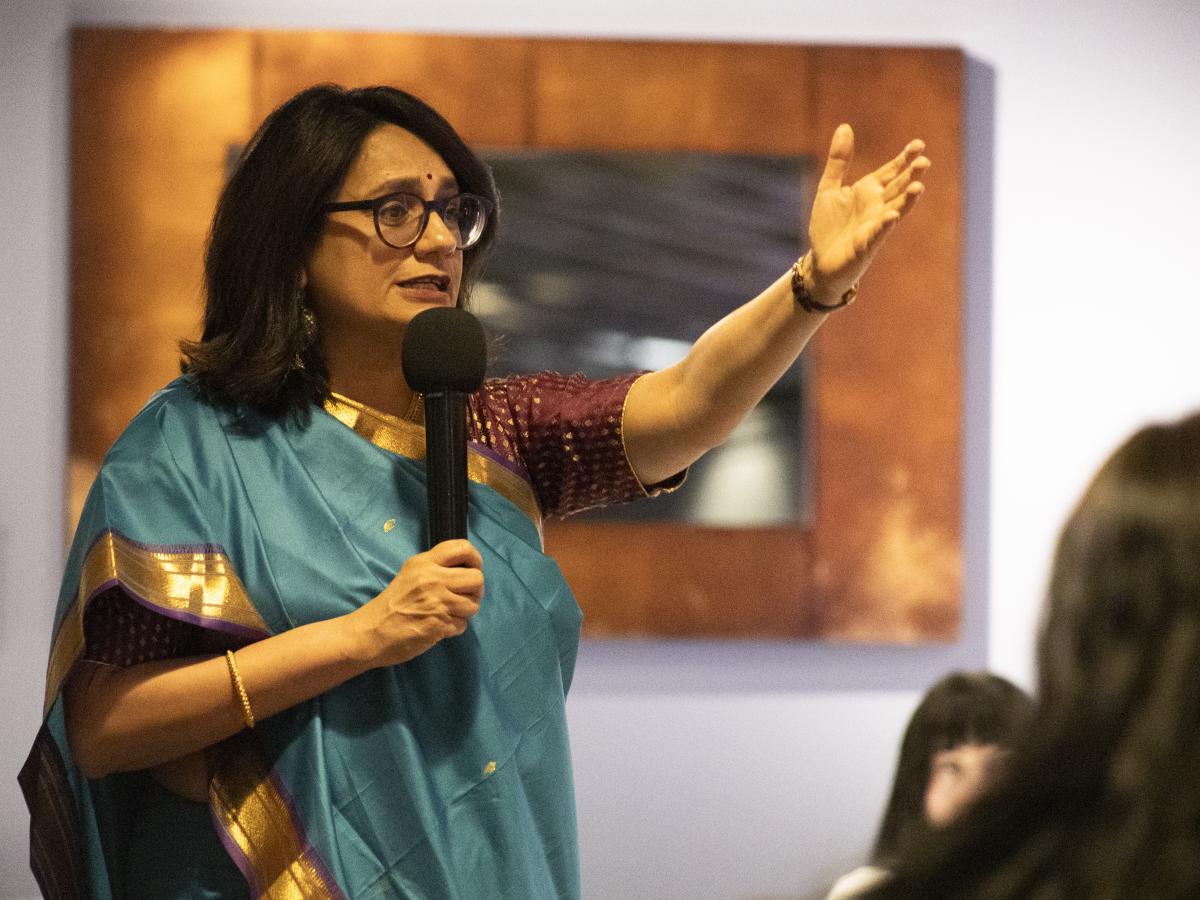
Tina Bhargava, DrPH, is a professor in 91²Ö¿â’s College of Public Health. She was a table facilitator and said, “It's really good to know that there are so many people from across campus who care about these issues enough to make the time for this kind of an effort. I think there were some really interesting perspectives that came up from students struggling with mental health issues, but also faculty and staff having a hard time and thinking about how we as a community can kind of shape things to make them better.â€�
“There are things I heard that I haven't heard before, and since I teach public health and I teach this area a lot, that's surprising. It's good to hear other things than what I've heard before,� she said.
Bhargava said, “I think that we should do more of these, and I would look forward to seeing some virtual options for our Regional Campus students or some Regional Campus options, but also for our online students.�
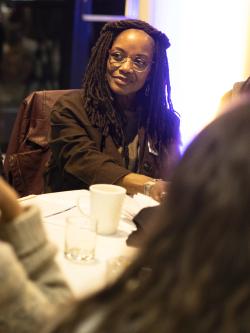
Amoaba Gooden, Ph.D., vice president of 91²Ö¿â’s Division of People, Culture and Belonging, was a facilitator at her table. She said, “That was a really successful program and I've got a couple of takeaways. One is that we all need to feel like we belong, right? And we all have to work on building community outside of our familiar spaces and to build that community across difference.â€�
“And then the other thing I'm taking away is this idea of critical hope, that multiple things can be true at the same time, that yes, we are experiencing heightened division across political divide, but despite that, we can still and we still do have community,� said Gooden.
'That’s Really How We Build a Sense of Belonging'
Following the overwhelmingly positive response to this event’s revival, there are two Dinner with Friends events being planned for the fall.
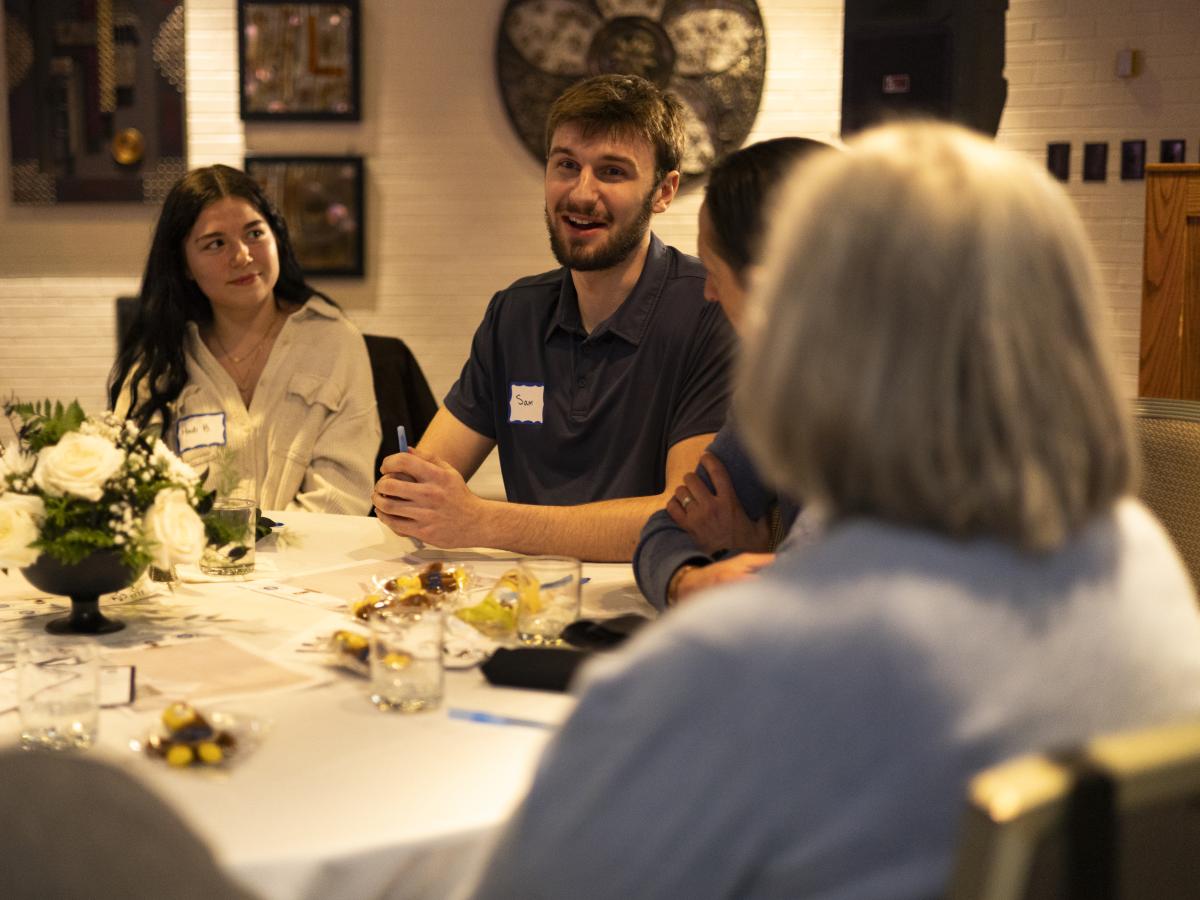
“For us, the main focus is on the feeling that people have connecting with each other – talking about something of some significant importance that everyone at the table shares a stake in,â€� said Berger. “And that, moving forward they’ve had the experience of connecting with people they don’t know talking about something important. Because in the end, that’s how we build a sense of belonging. That’s how we strengthen our sense of community at 91²Ö¿â. And for us, that’s the main outcome.â€�
Special thanks to Craig Berger, Sonia Karkare and Anthony Albanese for their support in telling this story.