Twenty-five years after the 9/11 attacks, journalists who covered that day still remember the uncertainty and urgency that shaped their work.
91²Ö¿â School of Media and Journalism faculty members were among those working in newsrooms that day, springing into action to cover the developing tragedy and help the American public understand what happened.
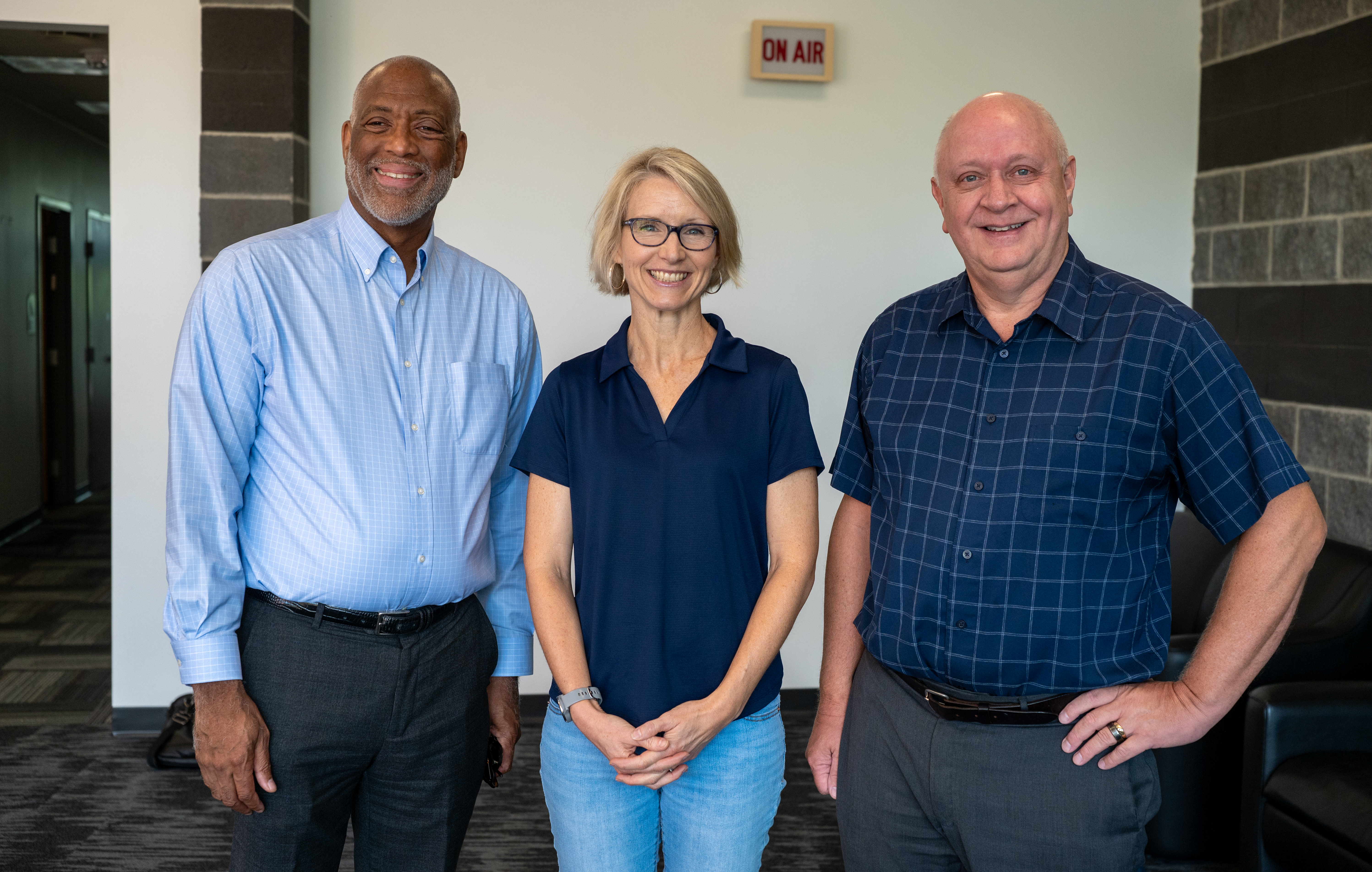
They recently told 91²Ö¿â Today how their experiences continue to influence how they teach the next generation of journalists to cover traumatic events.

91²Ö¿â Today
25 Years Later, 91²Ö¿â Journalism Professors Reflect on Covering 9/11 and Its Lasting Lessons
Your browser cannot play this audio. .
Anna Huntsman: It's been 25 years since the September 11th attacks, but the poignant, heartbreaking moments of that day are still fresh in the minds of many Americans. Maybe you remember the wall-to-wall TV coverage or saw the images in your local newspaper that night of the fiery blaze, the crash in Shanksville, the falling man. News coverage was nonstop and several faculty members in 91²Ö¿â's School of Media and Journalism were part of it. Associate Professor Dr. Gretchen Hoak was a TV reporter on the police beat for a Toledo NBC affiliate. Mitch McKinney, associate professor and undergraduate coordinator, was an editor at the Akron Beacon Journal. And professional in residence, Mizell Stewart III was managing editor of the Tallahassee Democrat. I'm Anna Huntsman with 91²Ö¿â Today. I recently talked with them about what it was like to be a working journalist that day and how the experience influenced how they teach today's students to cover difficult and even traumatic news stories.
This conversation has been edited for time.
Gretchen, once you found out about what was going on, how did that change your day, change your beat? What was your immediate assignment and how did you follow up?
Dr. Gretchen Hoak: Well, it's really funny because I was listening to the radio on my way in and they started talking about. And it was like a music radio station. So all of a sudden they were talking about this plane hitting the building. And I was like, "What the heck?" Nobody really knew what was going on. So once I figured out that this was maybe going to be a big deal, I was already heading to the Central Police District Station in Toledo. So I got up to the floor where I normally checked in with everyone and they're like, "Get over here, get in here, get in here." And we're watching in this lieutenant's office and we watched the second plane hit together. I remember everyone kind of went, "Whoa." And you hear all these voices and everyone's like, "Oh my God." Everyone's watching TVs and anywhere that they were available.
And everyone kind of looked at me and I remember the one officer was like, "You got to go." And I'm like, "Yeah, I got to go. I got to go now." And so I just took off and headed immediately to the station. And obviously anything that I had been planning or thinking about what my day was going to be was now out the window, but it took us some time to figure out what it meant for us on the local level and where do we go? And from then on, I was spot to spot to spot to spot, live shot, live shot, live shot ... as the story continued to develop and things locally started to kind of manifest. There is an airport in Toledo, which is not like your Cleveland Hopkins, but it is still a sizable airport where little commuter jets and things would come in.
And there was some concern about that airport and would there be planes? And Toledo's got a lot of nuclear plants around it. So there was a lot of concern that we may be a place where something might happen because the planes hadn't been grounded yet. So it was still sort of like, oh no. So I went out to the airport, did a live shot. And so normally I was like a nine to six. I was a day side. So after that six o'clock newscast, normally I would've gone home, but obviously that wasn't on the table. So went right back out, did a lot of vigils, a lot of reaction type stuff.
Anna Huntsman: Mitch, you were at a local newspaper. How did the Akron Beacon Journal spring into action and cover this developing story?
Mitch McKenney: Well, right after we realized what was happening, a number of reporters started heading places. Some went to Cleveland Airport, someone to Akron U just to see what people were seeing on the TVs there. And that actually was our headline.
At some point pretty early, the management figured out we're going to do an extra edition and we need to produce this in about an hour and take what was today's front page, swap out a few pages and run to press. And so hadn't done one of those in decades. And so all of our energy then went to, okay, what can we get in that extra edition? Anyone who knew someone in New York, can we call them and find out what's going on with them? And really looking for local connections. And of course, Cleveland Airspace was included and there was a question is was there still a plane in the air?
We didn't know. It was very confusing at that time. And so just trying to sort that out for something we could say pretty definitively in an hour while a lot of it was unclear. So we heard there was a plane down near Somerset, PA. We didn't know Shanksville at that moment. And so I'm walking over to a reporter saying, "We need you to go." And a few moments later I heard her calling her mom and she said, "No, no mom. I'm going to be fine. I'll have a photographer with me." Which made me kind of laugh. Okay, that's your security, I guess. Somebody with a camera is there. And that she said, "All the planes are down. There are no more planes." And at that moment, we really weren't clear yet that this was over, what else could happen? And so I still think of that moment as how confusing things were.
I'm looking out the window of this downtown Akron building and it's a beautiful clear day and there are no planes up and I don't want to see a plane right now. You're looking out there and just kind of thinking, okay, this is a time when everybody really felt vulnerable.
Anna Huntsman: Mizell, you were in a leadership role, right? Managing editor. So talk about what that was like of supervising all this and how did you kind of mobilize again as you were realizing what was going on?
Mizell Stewart III: We were near television sets that morning. A group of us were clustered around the TV. The second plane hit and instantly we were like, okay, this is serious. This is utterly unusual. We better start mobilizing. And then instantly we began thinking about, okay, have we updated the website? Because this was the early days of digital news. Have we updated the website? And then should we actually go on the street with an extra addition? And we made that decision very, very quickly and then set about figuring, okay, well, what do we put into it? And so we sent reporters out to places where people gathered. So we had people at the state capitol. We had people at Florida State University and Florida A&M University. We had people go to the shopping mall. We reached out to parents who were concerned about their children. And then fairly quickly, we got word because we had reporters at our sister newspapers around the state that President Bush was in Sarasota at the time that the plane hit the building.
And so we were beginning to really get a picture of what was happening in terms of the national chain of command at that same time. But perhaps the most vivid memory of that morning as we were very quickly making decisions and putting things together was what headline are we going to put on the extra edition given that we didn't really know intimate details in terms of who might be responsible? And I remember we had a huddle outside my office for about 10 minutes to try to figure out, okay, what headline is going to convey the seriousness of what happened while at the same time being accurate in terms of what we know at this moment? And so our headline that morning was America attacked. No blame, but describing from the facts that we had available, that's exactly what happened that morning.
Anna Huntsman: And all the while, you are all processing a huge tragedy and a lot of questions. And Gretchen, what was that like? Did you feel it in the moment or was there some point during the day where you took a breath and kind of realized what was going on?
Dr. Gretchen Hoak: It was almost like unprocessable. You're watching all this stuff unfold and then all of a sudden it's like go, go, go, go, go. Now we do our jobs. And I think for me, I was so focused on what's my job in this and doing that, that I was able to push away sort of the significance of what was happening. And I think that looking back, I don't know that I ever felt fear for myself. I never thought that this was coming to Toledo, but at the same time I felt incredibly unsettled. And by the evening, I remember kind of getting back, it was like 11:30, 11:40 by the time I got back and there was somebody had ordered pizza like five hours ago and I'm like, I'm slamming that because I'm hungry and I haven't seen food in a very long time. And I think it was that moment, eating the pizza and being able to calm down.
And then I stepped outside to go home finally knowing I was going to have to turn around and come back very quickly. And because of the Toledo airport and where our station sat, there was always airplanes in the air. And I went outside and I looked up and there was nothing. There was nothing there. No streaks, no little lights, and that sky was always full of airplanes. And I remember that being kind of the moment where I took a breath and I was like, "Wow, this was bad." And it's not like I didn't know it was bad, but I just didn't feel the bad until that moment when I was no longer required to work. And I kind of sat down and was like, "Geez, this was a very, very big deal, a life altering big deal. Everything's different. Everything's different now." And I remember not knowing what that meant for me, but just knowing that yes, things were different.
Anna Huntsman: Mitch, there's a picture you had shared with me of some Beacon Journal staffers watching the TVs. I was looking at it. I can see there's some uncertainty and it does seem to be a little bit of fear on the faces. How did you process that day as you were still trying to work and get out the newspaper?
Mitch McKenney: And it's kind of like Gretchen said, you're not necessarily thinking about it in the moment, but it was really unsettling and you're hearing stray things that might be true or not true. Is there still a plane in the air in Cleveland airspace like the Cleveland Mayor said? What's true, what's not, and is this over yet? And one thing that comes to mind though is how much the journalists in the room all just go into that mode. They start making calls. They go out to a place where they're going to get a chance to talk to some people or checking the gas stations or things like that. And so in that moment, you don't necessarily think, okay, how's everything going to be different going forward? And so it wasn't until I got home and I turned the TV on, of course it's on every station and they are replaying the footage again and again.
Our oldest was a preschooler and he hadn't been around the TV with this on yet until that moment. He walks in the living room and it's like he's watching a movie scene with an explosion and he goes, "Whoa." And I'm like, "No, no buddy, that's not a good one." And having to not necessarily completely explain this, but to indicate this was real and this was tragic and that it sort of all comes back to wow, okay, we're all experiencing this.
Anna Huntsman: Here at 91²Ö¿â, Gretchen, you have extensively researched journalists who have covered traumatic events and how that has affected them. When you're thinking about nine eleven, does that research background make you look at it differently and what do you think about?
Dr. Gretchen Hoak: It's interesting because nine eleven from a research standpoint was one of those moments that really started to put journalists' mental health on the map, if you will. And it started to become this kind of nascent conversation because for the journalists who were there, you couldn't possibly have done that and come away unscathed. And many of them were hurt. There was a lot of things that happened physically to those journalists, but even those who managed to be down there covering things, not get hurt and still walked away from that scene. There was a lot that happened to those folks from a mental and psychological standpoint. And there's actually a lot of research on those folks that covered that and had come out of that and was really instrumental in kind of starting the ball rolling on this conversation about what the job can do to journalists and kind of recognizing that.
And I think looking back, from my standpoint, knowing what I know now about how journalists react to trauma and tragedy like that, I recognize that I am sort of a grade A compartmentalizer and that is exactly what I did. I took the emotional moment or the emotional fuel of that incident and I put it in my pocket and I ignored it. And it was over time, especially once the week kind of ended and flights resumed and they stopped doing the 24 hour coverage that I was finally able to look in my pocket and pull it out there and really to myself, think about how I felt. And it was a lot. And I do remember several days later kind of having a good fat cry and feeling very good about having done that because there was some relief in that. So yeah, I think knowing what I know now and kind of looking back to how I handled it and the emotions that I was feeling at the time, I kind of give myself a little grace for that and understand that it absolutely.
I wasn't in New York, but the experience was 100% able to be traumatizing to some degree given what was happening and sort of the ripple effects across the country.
Anna Huntsman: As an educator teaching the next generation of journalists, do you ever talk about nine eleven in your classes? How did that shape how you teach students?
Mitch McKenney: I do. Every fall when we come around to nine eleven and I show those pictures that were in the newsroom, what it looked like that day and then review a little bit about what we were thinking. You have to really be prepared for a difficult story like that, but that's the sort of work you want to do. You want to think about what's the story that's not being told? Where's the way I can bring it down to a level where it really has meaning for folks?
Dr. Gretchen Hoak: They do try to use it just as a way to explain not so much about how do you cover something like that because I don't know that anybody knows how to cover something like that. You just go and do and it unfolds and you roll with it and you do your best to react in the moment and stick to what you know. But using it as an example of like, hey, this is a big thing and you are allowed to have feelings about it and how you process those and how you decide whether or not those feelings go into a story is something to be considered. And it's a great teaching point because I think that yes, as a journalist, we're taught to be objective and no feelings, but that's something you see people jumping out of a building because they'd rather jump than burn.
There's feeling there and it would be absolutely robotic if you didn't have feeling when you're reporting on something like that. So I think it is from a teaching perspective, a good example of how something tragic can impact you and how you negotiate that line of what comes into the story in terms of feeling and what you sort of keep at bay.
Anna Huntsman: Mizell, what about you?
Mizell Stewart III: A lot of what we talk about in our classes is how do we recognize those feelings? How do we manage those feelings? How do we separate that for the time period that we have to get answers to some critical questions, but at the same time channel those emotions in productive ways? I mean, I think sometimes those emotions lead to deeper stories, better stories. So it's not that you're putting them aside completely, but what you're doing is focusing on what is the task at hand? How do we approach these difficult circumstances with empathy for the people that we're dealing with, but also take those emotions and say, okay, is there more to the story that allows us to feel in ways that are really consistent with our innermost values?
Anna Huntsman: Today's 18 to 22 year olds, it's been 25 years since nine eleven, so a lot of students weren't alive yet. What is that like teaching a generation that wasn't there?
Dr. Gretchen Hoak: I think you take an event like September 11th and it was so pivotal for our nation and there's so many things about our world now that are a direct result of nine eleven that I think it's so important even more so that we bring it to their attention, whether that be from a journalistic standpoint or just from a historical standpoint to get them to understand how much of their world is a post nine eleven world and the impact of that cannot be kind of understated in any way.
Mizell Stewart III: That is one of the charges I think we have as educators for our students and how do we put what we've learned throughout history into practice as we pursue storytelling going forward. We talk about Watergate, we talk about the Pentagon papers, we talk about nine eleven. And I remember Watergate, I was alive, but I was not very old, but it's still as a journalist because of the people who brought that entire investigation to my attention through my education, it's very vivid to me. And I think we can accomplish the same thing with nine eleven and other historical events.
Anna Huntsman: Well, thank you so much for taking the time. It's been great to not only hear you reflect about what it was like to be a working journalist that day, but also how you use that now in the classroom and in working with students here at 91²Ö¿â. Thanks so much to Gretchen Hoak, Mitch McKinney and Mizell Stewart.
Mitch McKenney: Thank you.
“I'm looking out the window of this downtown Akron building, and it's a beautiful clear day, and there are no planes up,� recalled Mitch McKenney, associate professor and a former metro editor of the Akron Beacon Journal. “You're looking out there and just kind of thinking, 'OK.' This is a time when everybody really felt vulnerable.’�
Associate Professor Gretchen Hoak, Ph.D., who now researches the effects that covering traumatic news stories can have on journalists, said 9/11 was one of the first events to bring journalists’ mental health into a broader national conversation.
“There was a lot that happened to those folks from a mental and psychological standpoint,� Hoak said. “[9/11] was really instrumental in kind of starting the ball rolling on this conversation about what the job can do to journalists.�
All three faculty members said their experiences covering 9/11 shaped how they teach students to cover difficult events.
“A lot of what we talk about in our classes is, how do we recognize those feelings? How do we manage those feelings?� said Mizell Stewart III, professional in residence. “How do we separate that, for the time period that we have to get answers to some critical questions, but at the same time, channel those emotions in productive ways? I mean, I think sometimes those emotions lead to deeper stories, better stories.�
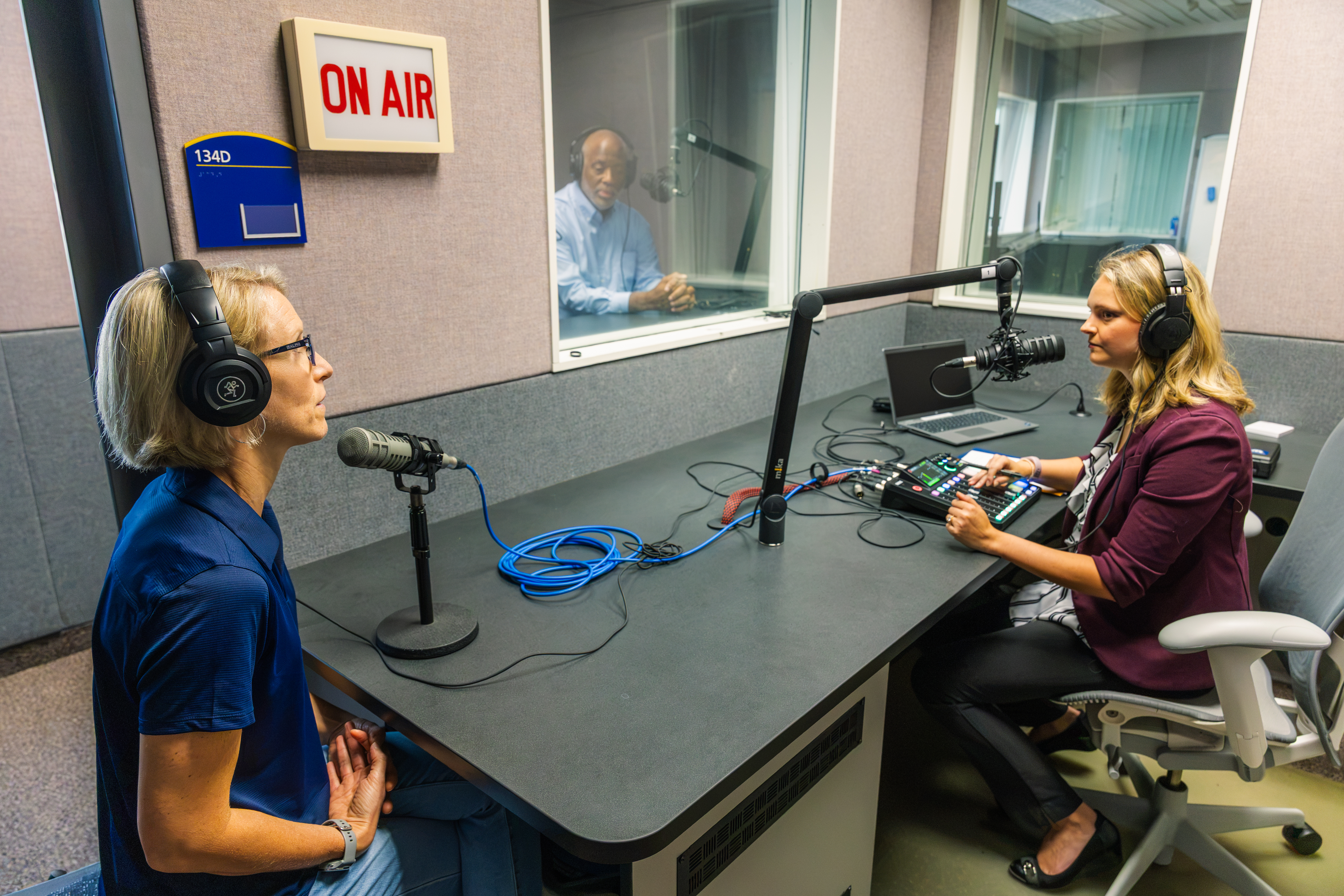
Podcast Highlights:
00:00 Hoak, McKenney and Stewart reflect on where they were working that day and how their newsrooms pivoted to cover the developing story.
08:05 Hoak and McKenney discuss processing their emotions in the following days.
11:58 Hoak discusses her doctoral research on journalism and trauma at 91²Ö¿â, and how Sept. 11 helped put journalists’ mental health on the map.
14:35 McKenney, Hoak and Stewart share how they teach 91²Ö¿â students about Sept. 11 and the importance of recognizing emotions while covering difficult stories.
The conversation features:
- Gretchen Hoak, Ph.D., associate professor of journalism, who was a television reporter covering the police beat for a Toledo NBC affiliate.
- Mitch McKenney, associate professor and undergraduate coordinator, who was an editor at the Akron Beacon Journal.
- Mizell Stewart III, professional-in-residence at the School of Media and Journalism, then-managing editor of the Tallahassee Democrat.
- Anna Huntsman, content creator at University Communications and Marketing.