
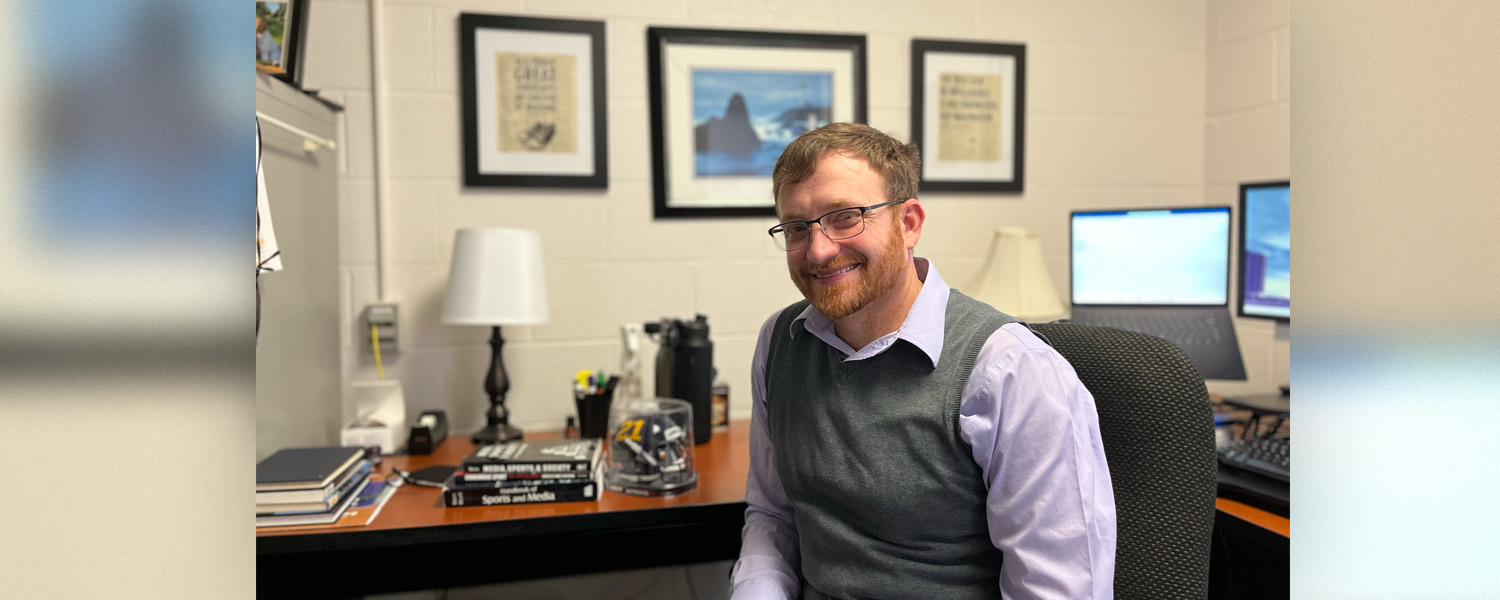
When Buffalo Bills safety Damar Hamlin collapsed on the playing field in early January while experiencing a cardiac episode, “it was one of those massive situations that cause us to rethink the role of sports in society,” according to 91²ֿâ Associate Professor JD Ponder.
Ponder, who has studied sports, communication and society, is teaching Sports Communication in the School of Communication Studies this semester and recently reflected about what football fans — and the rest of America — saw unfold during and following the Jan. 2, 2023, NFL game.
In terms of communication, it’s been “a mix of good and bad,” he says.
One example of “the bad,” he says, was the NFL’s response in real time. In every class, Ponder instills upon his students that in the absence of communication, mixed messages, misinformation and misinterpretation can percolate — and that’s much of what we saw from the NFL’s initial response.
“There was a lot of confusion on the telecast about what was going on,” he said, as analysts and commentators predicted whether the game would be canceled. When it ultimately was, confusion unfolded as to whether coaches or the NFL were behind this decision.
“But that confusion that was manifest in the sports arena, that’s a really good example of poor communication happening,” he says.
“… And since there’s a mixed message, it lends itself to misinterpretation. As an organization, you never want to give that opportunity for misinterpretation. You always want to control the narrative.”
Sports communicators in particular, Ponder says, need to be prepared to handle crises in front of millions of eyes — and often.
“The majority of sports crises that we see happen in front of the fans, and that’s a very unique thing,” he says. “Rarely do you ever see millions of people watching a crisis occur in real time that’s affecting another (type of) organization, but sports are one of those areas where this regularly occurs.”
In Sports Communication, Ponder teaches a multi-step process for managing a sports crisis — and much of that involves having a solid playbook in place so that when a crisis happens, communicators and leaders know what to do. Based on what he saw unfold, Ponder says it doesn’t look like the NFL or broadcast media were following any sort of playbook.
On the flip side, Ponder says the communication from the Buffalo Bills surrounding Hamlin’s condition has been particularly well done. It’s a lesson his students can learn about practicing empathy and sensitivity as communicators when dealing with a crisis.
“(The Bills) have been respectful of Damar’s wishes and Damar’s family’s wishes — the right to privacy as well,” he says. “… You have to negotiate with Damar and Damar’s family, ‘Hey, what do you want to talk about? What do you want to keep back?’ … And that takes thought and caring and empathy when you’re having those discussions.”
The power of communication to do good in the world has also been on display, Ponder says, as on social media, fans quickly shared Hamlin’s charity, The Chasing M Foundation, and raised more than $8 million for a community toy drive.
As sports leaders, communicators and media learn from this instance, Ponder says he expects to see more emphasis on health issues and preparation to talk about them.
“I think there should be more training about how announcers should deal with these situations and what the protocols should be,” he says. “They should always have medical experts on first … allowing experts that spot to be called in to talk about these things.”