
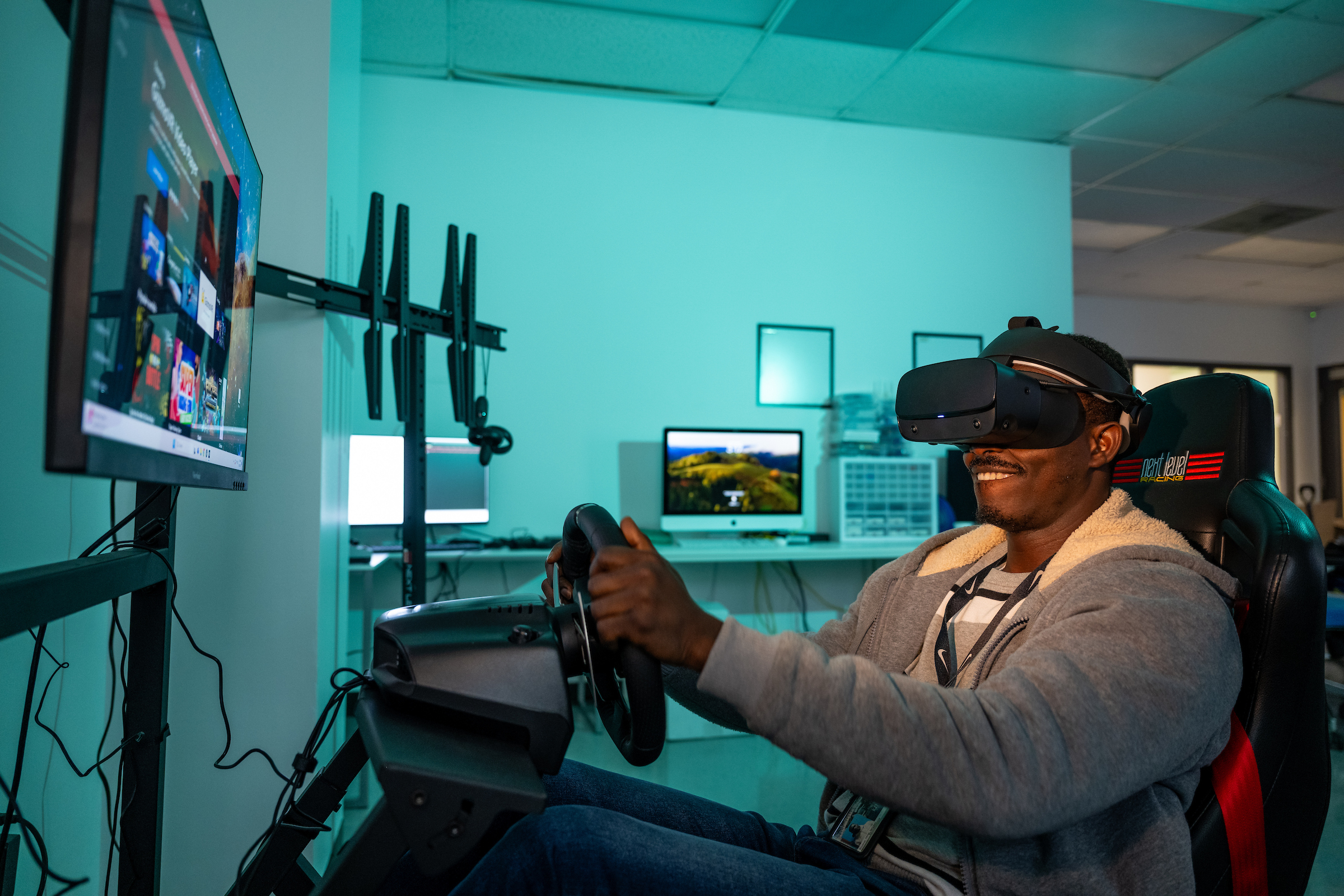
Sampson Addae spent a decade building and managing telecommunications infrastructure for millions of people across Ghana. He was good at his job, his managing director didn't want him to leave -- but after ten years, something was missing. He wanted to do work that felt more personal, more urgent. He wanted to build technology that could save lives.
He applied to 91²Ö¿â, received an assistantship offer, and arrived in January 2022 ready to pursue a Ph.D. in computer science. What he didn't expect was that a medical emergency just four months later would give his research its defining purpose.
A Crisis That Became a Calling
Shortly after arriving at 91²Ö¿â, Addae experienced a life-threatening health problem that sent him to the emergency room. His doctors found the problem and fixed it. He survived.
"After that, I kept thinking about people who aren't as lucky," Addae said. "Can I do something more meaningful and impactful to help in this space?"
That question put him to work. Now a fifth-year Ph.D. candidate in the Smart Community and Internet of Things Laboratory, Addae works under advisor Jungyoon Kim, Ph.D. at the intersection of health informatics, AI and Internet of Things technology. His research builds small, intelligent AI models designed to predict problems before they become emergencies.
Small Models, Big Impact
One strand of Addae's work focuses on predicting the risk of rebleeding in patients who arrive at hospitals with gastrointestinal issues — helping doctors quickly identify who needs urgent attention when resources are stretched thin.
Another uses what the field calls TinyML: AI models so compact they can run on a microcontroller. His stroke rehabilitation model, for instance, is under 70 kilobytes. These miniature models can be embedded in sensors placed in homes, community spaces, or industrial areas to detect and monitor air pollution in real time.
"Think about the Canadian wildfires a couple years ago," Addae said. “When the smoke came down into Ohio and everything went hazy. Vulnerable people such as the elderly, children, people with asthma can face real long-term risks from that kind of exposure. There's evidence linking prolonged air pollution exposure to Alzheimer's and dementia. We want to detect these things before they become emergencies."
He also collaborates with physicians and physiotherapists on stroke rehabilitation research, part of the broader health-and-technology mission that animates his entire program.
A Decade in Industry, a New Direction
Addae's path to 91²Ö¿â wasn't a straight line. After finishing his undergraduate degree in computer science in 2011, he joined Huawei Technologies, eventually managing optical network deployments and service level agreements in a role where his phone was never off, because network outages had national security implications. He rose to project manager before deciding, at 10 years in, to return to school.
"My managing director was sad to see me go," Addae said. "But I wanted to do something more impactful."
Why 91²Ö¿â — and What Comes Next
Addae credits the department's support staff, faculty, and diverse student community with making his transition smooth. He plans to stay in academia after graduating, returning the kind of investment the university made in him by training the next generation of technologists.
His advice to international students eyeing graduate programs is the same message he's lived by for over a decade.
"Don't give up on your dream,� Addae said. “I chased mine for ten years. Rejections are just a reason to regroup and keep going. One day you'll be telling your own story."