
For 100 years, The 91²Ö¿âr has chronicled the people, events and moments that have transformed 91²Ö¿â and the world beyond its campus.
This fall, as 91²Ö¿â celebrates its centennial with the Homecoming theme “,â€� generations of those storytellers will return to campus. Former 91²Ö¿âr staff members have been invited to serve as , celebrating a century of student journalism and countless stories told along the way.
The story of The 91²Ö¿âr began Feb. 25, 1926, when the first issue of the student publication, then known as The Searchlight, was published. In July of that same year, the publication took the name it carries today. In 1953, The 91²Ö¿âr adopted a daily publishing schedule, further establishing its place in the life of the growing university.
From its earliest days, the newspaper has chronicled more than just campus events. Its pages have captured moments of local, national and international significance, offering generations of 91²Ö¿â students a view of the world and maintaining a record of how that world was experienced on campus.
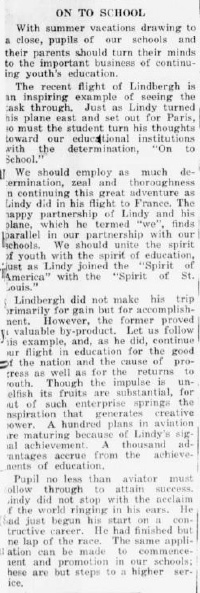
The 91²Ö¿âr’s pages have long connected 91²Ö¿â to the larger world. In 1927, the newspaper chronicled Charles Lindbergh’s historic transatlantic flight, capturing a moment that had taken over the nation. The story appeared alongside the everyday news of campus life, reflecting the role the student publication would continue to play for the next century.
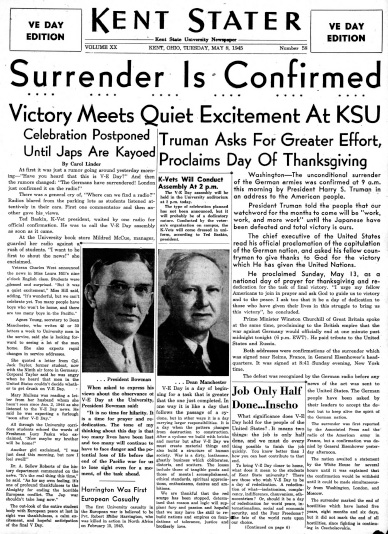
The 91²Ö¿âr’s coverage of V-E Day in 1945, brought the end of the war in Europe directly into the 91²Ö¿â community. Students gathered around radios waiting for official confirmation of Germany’s surrender. Others thought about family members serving overseas and the possibility that they might finally return home. The issue did more than report the news; it captured the emotions surrounding it. Students expressed relief and hope while recognizing that the war in the Pacific continued. The paper also identified 91²Ö¿â students who were missing in action overseas, connecting a historic global event to the university’s own community.
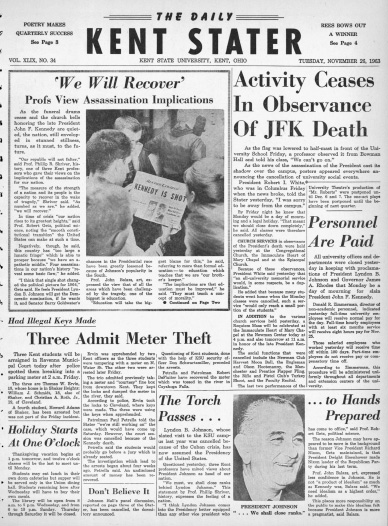
Eighteen years later, The 91²Ö¿âr documented a moment of national tragedy. Following the assasination of President John F. Kennedy in November 1963, the newspaper reported on the implications of the assasination through the perspectives of 91²Ö¿â professors, while also capturing the immediate reactions of students. Classes and campus activities were canceled as the university observed a period of mourning.
Then, in 1970, the story was no longer happening somewhere else. There was no issue of The 91²Ö¿âr published on May 4, 1970. At the time, despite its title, the newspaper was published Tuesday through Friday during the regular academic term. Following the shootings that day, campus closed for several weeks and students were sent home. Publication was suspended until students returned to campus and the 91²Ö¿â Summer News resumed publication on June 26.
The absence of a May 4 issue is itself part of the newspaper’s history. The events that unfolded on campus changed the university, the nation and the lives of generations of Flashes. The 91²Ö¿âr would go on to chronicle the aftermath and the continuing conversation surrounding May 4. A year later, the publication reported on the Pulitzer Prize awarded to John Filo, a 91²Ö¿â senior journalism major, for photographs he took during May 4.
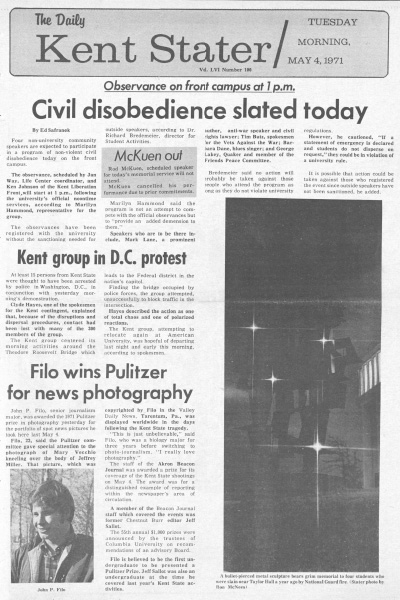
May 4 demonstrated another role The 91²Ö¿âr has played throughout history. It has not only brought events from around the world to 91²Ö¿â, but also helped document events that would go on to define 91²Ö¿â itself.
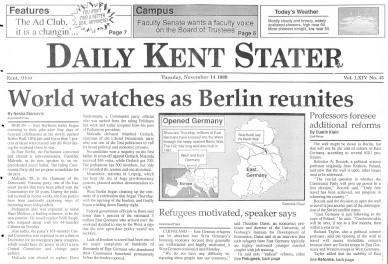
Nearly two decades later, the newspaper once again turned its attention beyond Kent. In 1989, The 91²Ö¿âr covered the fall of the Berlin Wall, a defining moment in the end of the Cold War. The coverage examined the significance of the event while also relying on 91²Ö¿â faculty for insight into what the changes might mean.
On Sept. 11, 2001, history once again arrived in a way that would change the world. The 91²Ö¿âr’s coverage of the terrorist attacks documented the immediate impact of the events and their effect on the 91²Ö¿â community. Like the issues that came before it, the paper served as both a record of a historic moment and a reflection of how students, faculty and the university community were experiencing it.

For a century, students have stepped into the newsroom to report on the experiences shaping their university and their world. They have documented the moments that made national headlines and the stories that mattered to the people who lived them. The medium has changed. The way students receive news has changed. The world itself has changed. But the need for students to tell 91²Ö¿â’s story has remained.
Now, 100 years after the first issue, the people who helped tell those stories will become part of one themselves. As former 91²Ö¿âr staff members lead the Homecoming parade, they will mark a century of student journalism and a tradition that has connected generations of Golden Flashes.
If you were a member of the 91²Ö¿âr staff and would like to sign up as a grand marshal, .
To share your story as part of Every Flash Has a Story, and share your experience as a video or written entry.
Visit the Homecoming website to learn more about what’s in store for Oct. 3 and to sign up to receive text messages so you don’t miss any of the action!